
The world of trading is filled with fascinating tools, and today we are going to dive into one of the most interesting: the Trailing Stop. If you’ve ever wondered how to automatically protect your profits while the market moves in your favor, you’re in the right place.
How the Trailing Stop Works
What is a Trailing Stop and What is it Used For?
The Trailing Stop is like having a personal bodyguard for your trades. Imagine an order that automatically adjusts while the price moves in your direction, always maintaining a fixed distance that you determine. It's essentially a dynamic stop order that ‘chases’ the price, protecting you from sudden market changes.
Differences Between Trailing Stop and Traditional Stop Loss
The traditional Stop Loss is like a line in the sand that doesn't move, whereas the Trailing Stop is more like a shadow following the price. The main difference lies in its adaptability: while the Stop Loss stays fixed at one level, the Trailing Stop adjusts automatically when the market moves in our favor.
How Does a Trailing Stop Order Work?
Let's take a simple example: you buy a stock at €100 and set a Trailing Stop at 5%. If the price rises to €110, your stop will automatically adjust to €104.5 (5% below). If the price continues to rise, the stop will keep moving upward, but if it falls, the stop will remain at its last highest level.
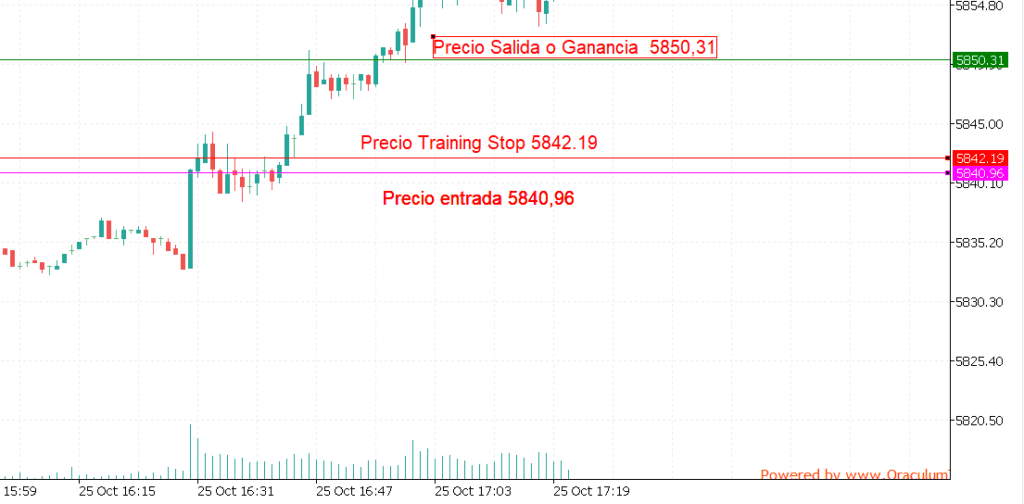
Implementation of Trailing Stop on Different Platforms
How to Set Up Trailing Stop on Binance
On Binance, you can activate the Trailing Stop from the trading window:
Select “Trailing Stop” in the order type
Define the trigger distance
Set the tracking percentage
Setting on MetaTrader 5 (MT5)
MT5 allows you to set the Trailing Stop in points:
Right-click on the open trade
Select “Trailing Stop”
Choose the distance in points
Using Trailing Stop on Interactive Brokers
Interactive Brokers offers advanced options:
Percentage-based Trailing Stop
Fixed amount Trailing Stop
Activation time Trailing Stop
Advantages and Disadvantages of Trailing Stop
Main Benefits of Trailing Stop
Automatic profit protection
Allows profits to run
Reduces emotional burden in trading
Optimizes time management
Limitations and Risks to Consider
May exit trades prematurely in volatile markets
Not effective in sideways ranges
Requires precise configuration based on the asset
Strategies and Best Practices
When to Use Trailing Stop?
The Trailing Stop shines particularly in:
Strong and defined trends
Long-term trades
Markets with moderate volatility
Recommended Percentages for the Trailing Stop
Percentages vary based on the asset:
Forex: 1-2%
Stocks: 3-5%
Cryptocurrencies: 5-10%
Tips to Maximize Effectiveness
Adjust the trailing according to the asset’s volatility
Combine it with technical analysis
Test different settings in demo first
Practical Examples of Trailing Stop
Case Study in Bullish Trades
In a bullish Bitcoin trend:
Entry: $30,000
Trailing Stop: 7%
Outcome: Exit at $42,000 after a 7% drop from a high of $45,000
Application in Bearish Markets
In short positions, the Trailing Stop moves down:
Short entry: $100
Trailing Stop: 5%
Exit: $85 after a 5% increase from lows
Frequently Asked Questions About Trailing Stop
Most Common Configurations
What distance is best?
It depends on your trading style and the asset
Can it be used in all markets?
Yes, but its effectiveness varies
Does it work in scalping?
It's not recommended due to volatility
Common Problems and Solutions
Premature exits: Increase trailing distance
Missed opportunities: Adjust according to volatility
Erroneous activation: Verify your platform settings
Remember that the Trailing Stop is just one tool in your trading arsenal. Its effectiveness will depend on how you integrate it into your overall strategy and your understanding of the market.